 Facebook
 Twitter
 LINE
LINE
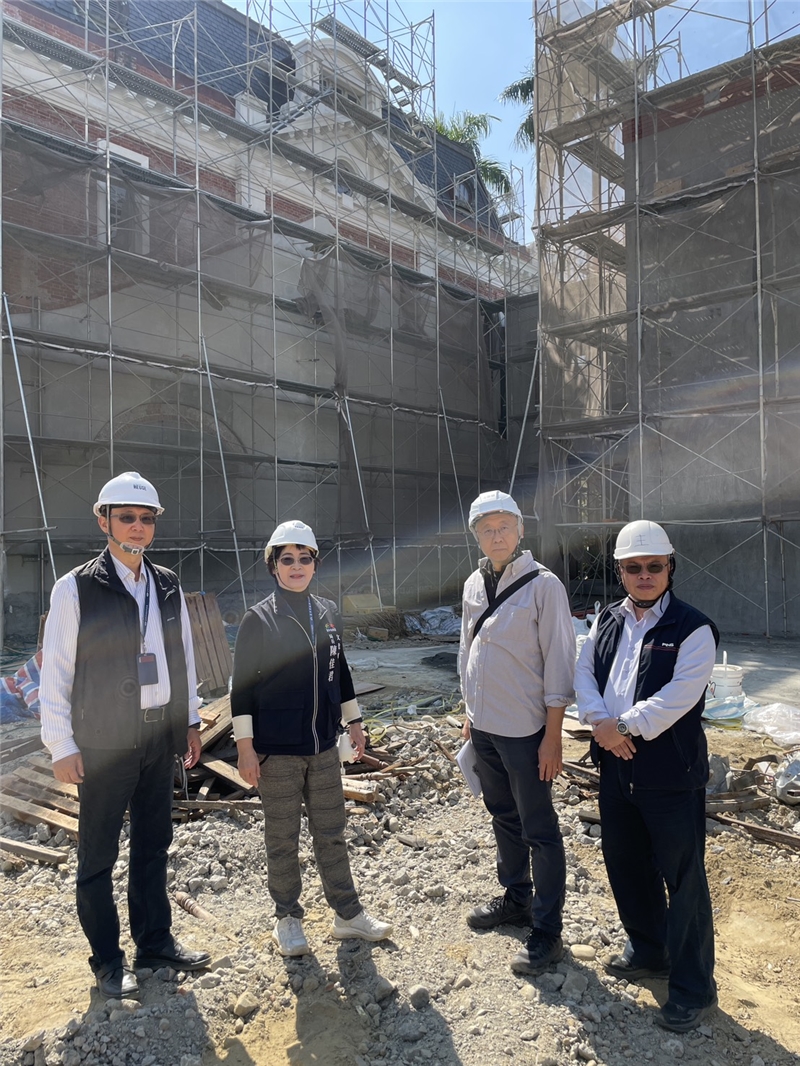
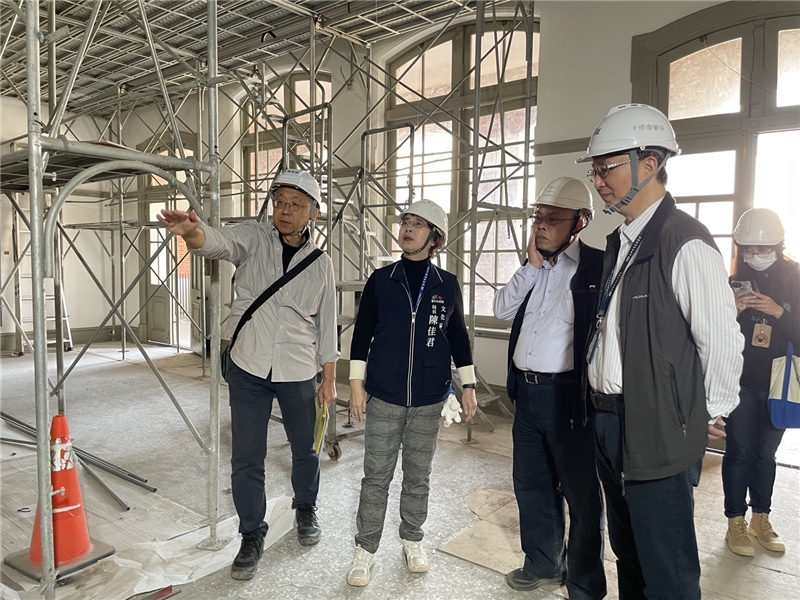
The "Taichung State Hall," a national monument carrying a century of historical memory, is currently undergoing intensive adaptive reuse construction. To ensure the transformation quality and progress of this precious cultural asset, Director Chen Chia-chun of the Taichung City Cultural Affairs Bureau led a team to the construction site for an inspection on the same day (13th). Participating units included heads of various departments from the Cultural Affairs Bureau, the Taichung City Office of Cultural Heritage, the design and supervision unit Kuo Chun-pei Architects & Associates, and the contractor Yu-Tian Construction Co., Ltd. Together, they conducted an on-site quality audit and safety review, demonstrating the city government’s high regard for the cultural revitalization of the Old City district.
The inspection on that day was guided throughout by Architect Kuo Chun-pei, who possesses extensive experience in cultural heritage restoration. Director Chen inspected the current progress and construction details of the interior decoration, landscaping, and mechanical, electrical, and fire protection systems. She requested that site safety management be particularly reinforced during the Lunar New Year period to protect the safety of this national monument. On-site, Director Chen specially encouraged the construction team, noting that the reuse project has entered a critical phase and must implement high-quality engineering details under the premise of strict adherence to construction safety.
Director Chen pointed out, "We have a responsibility to ensure that the State Hall is not just a static monument, but a dynamic space that truly integrates into the lives of citizens." Since its establishment in 1913 (Taisho 2), Taichung State Hall has always been the administrative core of Taichung. The total budget for this reuse project is NT$420 million, all of which was self-funded and allocated by the city government. After completion, the Cultural Affairs Bureau will move in for office use, complemented by arts and cultural exhibition spaces and outsourced areas open for citizen participation. The goal is to complete the project on schedule and with high quality by 2026, giving the monument a contemporary life.
Architect Kuo stated that to enable this century-old national monument to meet modern functional needs, the project includes a newly constructed building equipped with modern facilities such as mechanical and electrical systems, fire protection, elevators, and restrooms. It will also serve as the hub for water and electricity connections for the entire area, carrying the important mission of being the monument's life support system. The architectural design of the new building must consider echoing the appearance of the monument, with a volume that is as light and refined as possible so as not to affect the viewing of the original structure. Currently, the structural body of this new building is largely complete, and interior renovations of the monument along with outdoor landscaping are actively proceeding in parallel.
The Cultural Affairs Bureau stated that the revitalization philosophy for Taichung State Hall emphasizes the perfect fusion of "historical preservation" and "functional development." After the project is completed, the Cultural Affairs Bureau will move in to work, continuing its historical symbolism as a centennial office building. Through spatial recreation and functional upgrades, the first floor will be planned as an open, multi-functional arts and cultural exhibition space, while the second floor will serve as an administrative center. This model of "public administration and arts exhibition" running in parallel will not only maintain the historical context of the building's use but also allow citizens to walk freely through the century-old corridors and experience the charm of the historic architecture at close range.
The Office of Cultural Heritage added that the construction team also specially arranged an on-site inspection of office furniture prototypes on that same day, inviting various units to communicate and confirm details on-site to ensure the furniture meets both spatial aesthetics and practical needs. Through the revitalization of cultural heritage, the State Hall will transform into a public space with cultural depth shared with the citizens, evoking the public's collective memory of historical trajectories and further driving the recovery and prosperity of the cultural industries in the Old City district.