 Facebook
 Twitter
 LINE
LINE

The Cultural Affairs Bureau noted that artifact surveys serve as an essential starting point for cultural heritage preservation. In accordance with the Ministry of Culture’s Bureau of Cultural Heritage’s “Guidelines for the Registration and Tracking of Surveyed Artifacts,” the Cultural Heritage Department of Taichung City has, since launching the survey in 2017, completed work across 21 administrative districts—including Central, South, Beitun, Xitun, Dajia, Da’an, Fengyuan, Xinshe, and Dongshi. To date, the project has surveyed 59 schools and documented 907 cases comprising 4,668 artifacts. The upcoming fourth phase will continue in the districts of Qingshui, Wuqi, Longjing, Dadu, Wuri, Dali, Wufeng, and Heping, with the goal of completing the citywide archival survey of school artifacts established during the period under Japanese rule by 2029.
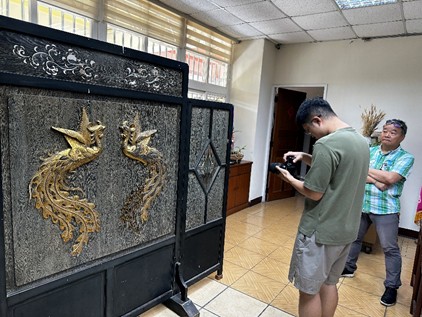
The Cultural Heritage Department noted that the third phase of the survey has identified several campus artifacts with potential for designation as “antiquities.” Among them are the “bomb-shell school bells” preserved at Neipu Elementary School, Wengzi Elementary School, and Dongbao Elementary School. Another remarkable example is the “Phoenix Folding Screen” at Daya Elementary School, distinguished by its black lacquered wooden frame, plain-sawing patterned panels, and exquisitely carved golden phoenix motifs. Originally used to conceal the imperial security storage cabinet, the screen symbolizes the sanctity of education and the authoritative nature of the learning space. Additionally, the “Promotion of Culture and Education” plaque at Tuniu Elementary School was donated by local gentry upon the school’s founding in 1926 (Taishō 15), embodying the educational ideals and cultural spirit of the community. The school’s name traces back to the Tuniu Public School, and together with the “Tuniu Boundary Stone between the Han and Indigenous Territories”—erected locally in 1761 (Qianlong 26)—forms an important historical link.
The Cultural Heritage Department further explained that artifacts with potential for designation as antiquities may be submitted by schools for review under the antiquities appraisal process. Once officially designated, schools may also apply to the Ministry of Culture’s Bureau of Cultural Heritage for related preservation grants in accordance with the Cultural Heritage Preservation Act. Beyond advancing the preservation of campus culture, the results of this survey can serve as valuable teaching materials for schools developing local culture curricula. Schools are encouraged to integrate these resources into their courses and community contexts by organizing school history rooms and interpreting artifacts, thereby fostering students’ sense of place and respect for cultural heritage.
The presentation event brought together representatives from multiple schools. Attending guests included Chang Li-Hsin, Secretary of the Taichung City Cultural Heritage Department; Lan Ci-Ling, Section Chief of the Education Bureau; Zhan Wen-Cheng, Principal of Ruishui Elementary School in Fengyuan District; and Zhang Wen-Yu, Principal of Chenggong Elementary School in Dongshi District. Schools including Houzong Senior High, Taichung Home Economics and Commercial Senior High School, Chenggong Elementary School, Zhongxiao Elementary School, Daya Elementary School, Dongxing Elementary School, Ruishui Elementary School, and the Affiliated Experimental Elementary School of National Taichung University of Education also participated. The event was full of lively exchanges and provided an opportunity to jointly witness a new chapter in the preservation of Taichung’s century-old school cultural heritage.