
 Facebook
 Twitter
 LINE
LINE
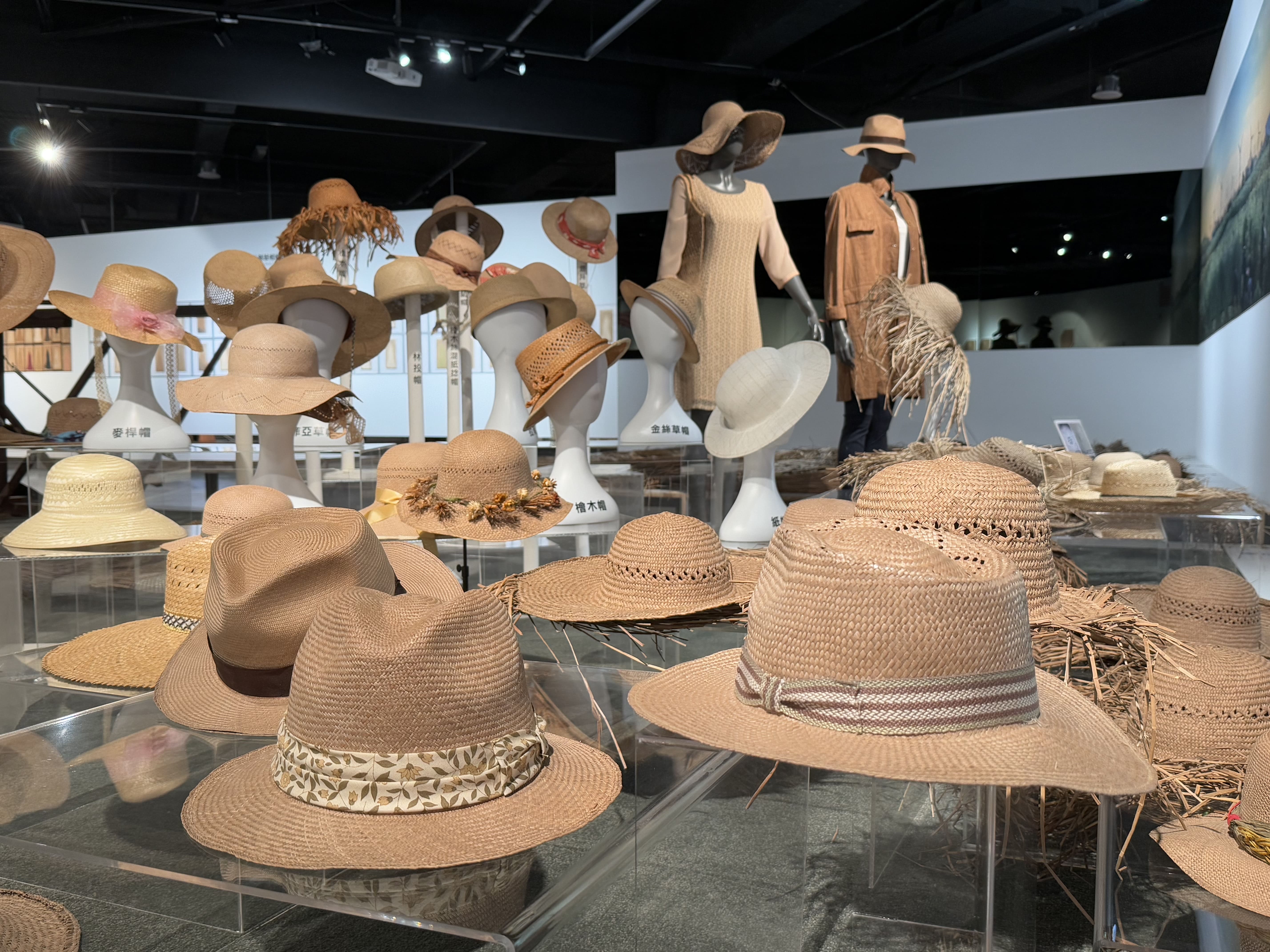
Straw hats are not only tools for sun protection but also fashion symbols of high society. The Taichung Fiber Arts Museum is currently holding the "The Kingdom of Straw Hats: A Miniature Exhibition"in the permanent exhibition hall on the second floor, showcasing precious hat samples donated by veteran hat industry exporter Mr.Yan-Shan Li, which have been sold to Europe and America since 1929. This unique collection of precious hat samples in the world fully records how Taiwan, a century ago, swept the international market with exquisite craftsmanship, becoming the third largest export product after sugar and rice, earning Taiwan a huge amount of foreign exchange.
Director Hui-Hua Jian of the Fiber Arts Museum stated that the 57 export hat samples exhibited this time are made from materials including palm, betel nut palm, cypress wood, hemp, paper yarn, and rayon. They incorporate the then-trending pastel color palette, perfectly matching the aesthetics of European and American social circles from a century ago, resembling a three-dimensional fashion encyclopedia. According to historical records, in 1929 alone, Taiwan exported as many as 290,000 straw hats, linking an industrial chain across seven coastal counties and cities along the western coast from Hsinchu to Kaohsiung. This not only created an "economic miracle" at the time but also earned Taiwan the reputation of the " Kingdom of Straw Hats."
The Fiber Arts Museum explains that in the early days, a high-quality Dajia rush straw hat was even more expensive than a full suit (equivalent to about 20,000 to 30,000 New Taiwan Dollars today). The process was extremely intricate; just the initial sun-drying took 30 days. The straw stems had to be split in half and the pith removed using fine needles. The level of craftsmanship was world-renowned, with strong sales across Asia, Europe, and America. It even influenced Panama, located 15,000 kilometers away, where locally produced Panama hats sell for about 20,000 New Taiwan Dollars each. The weaving of the hat base, the hat tube, the brim, and the molding and shaping processes are all similar to those of the Dajia rush hats.
Entering the "The Kingdom of Straw Hats: A Miniature Exhibition" feels like stepping into the daily life of women weaving straw hats at that time. From the age of six or seven, they followed their mothers and older sisters to learn the craft. Their fingers skillfully weaving not only provided the expenses for their children's education but also crafted for themselves the dignity of being laborers and a substantial dowry, showcasing women's economic strength. On the other hand, this industry also promoted the integration of the Pingpu, Hakka, and Hoklo ethnic groups, replacing competition with "craftsmanship" to achieve local coexistence and prosperity, having a profound impact on Taiwanese society.
Visitors are welcome to come to the Fiber Arts Museum to experience up close the glorious history of the Taiwan's "National Straw Hat Team" from a century ago connecting with international fashion. You can also visit the museum's "Tennii Studio" to purchase exquisite straw hats with heritage significance and personally experience this century-long sense of happiness. For more information on exhibitions and events, please visit the Fiber Arts Museum's official websiteor Facebook fan page .